
Work Packages
The overall objective of the project is to develop novel and generalising approaches for smart multidimensional measurements with significantly reduced experimental effort and validated uncertainty evaluation.
The specific objectives, which are considered in the following workpackages of the project, are:
- To develop automated machine learning approaches for the solution of general linear inverse problems based on digitised measurements, arising in scanning hyperspectral imaging (sHSI) or photocurrent mapping (PCM) of semiconductors. To go beyond the state of the art by basing and extending these approaches with techniques from compressed sensing, low-rank reconstruction, and deep learning. To also train machine learning models to represent prior knowledge and statistically regularise the inverse problem, using both real and synthetic data (WP1).
- To develop uncertainty evaluation methods for the approaches in objective 1 and create generalised tools to metrologically validate the uncertainty evaluation. These tools would include statistical uncertainty assessments and calibration analysis, as well as have the capacity to validate the robustness and reliability of the machine learning model (WP2).
- To develop automated and adaptive measurement strategies for the methods developed in objectives 1 and 2. To achieve a targeted measurement uncertainty while satisfying the constraints of specific metrology applications, such as scanning hyperspectral imaging or photocurrent mapping of semiconductors. To also define a digitised measurement framework to include data management strategies and appropriate automated feedback procedures (WP3).
- To implement the approaches developed in objectives 1 to 3, for metrological applications, such as scanning hyperspectral imaging and photocurrent mapping of semiconductors. To design automated and adaptive measurement strategies by taking into consideration any physical constraints imposed by measurement instruments or methodologies of the applications and develop experimental prototypes (WP4).
- To facilitate the take up of the technology and measurement infrastructure developed in the project by standards developing organisations and end users (semiconductor industry, medical imaging etc.) and to disseminate good practice guidelines and a public database for reference data to all relevant stakeholders (WP1-WP5).
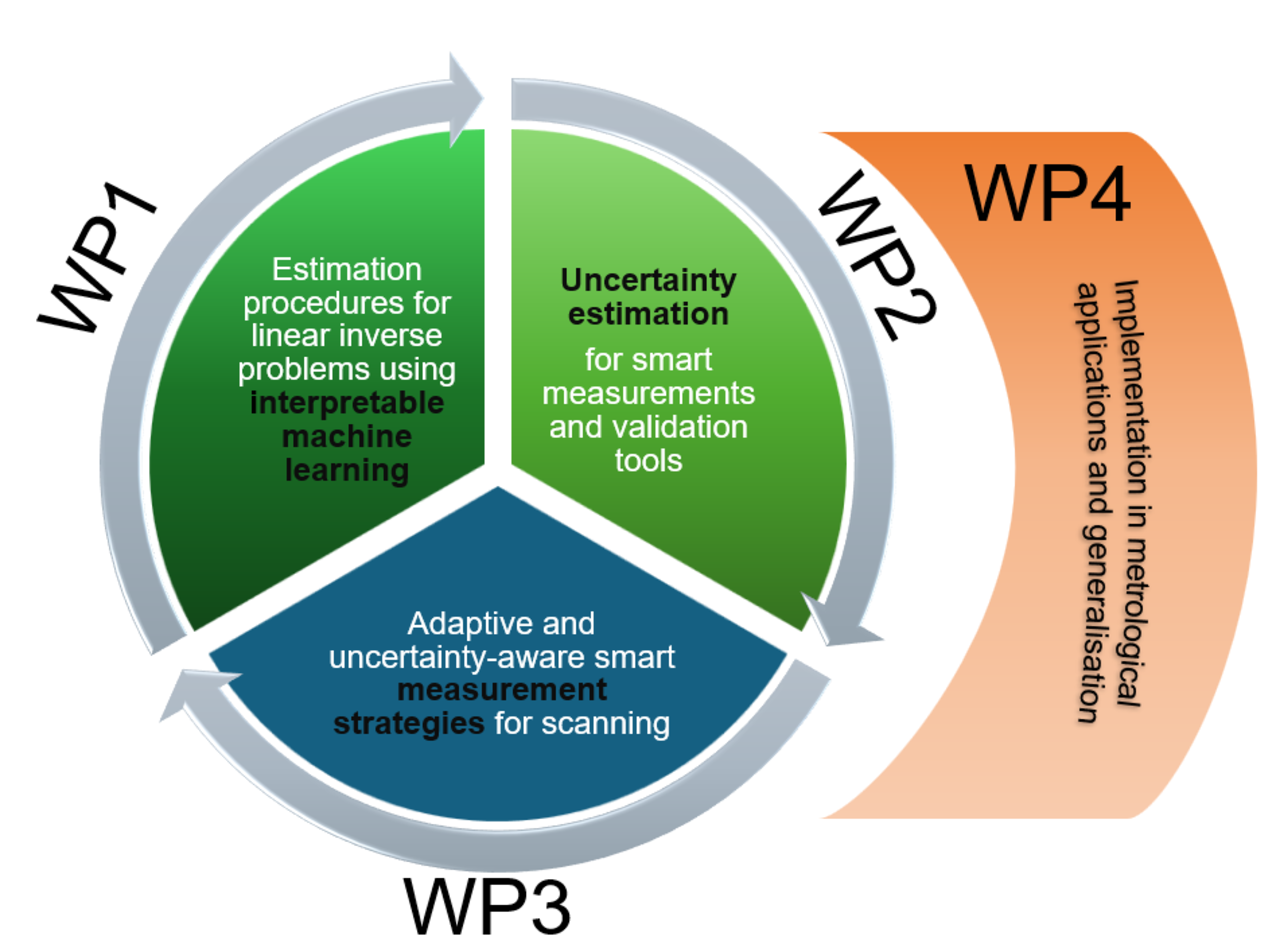
WP1 - Estimation procedures for linear inverse problems using ML
The aim of this work package is to develop generalisable ML approaches for estimating solutions to linear inverse problems arising in the applications scanning hyperspectral imaging (sHSI) and photocurrent mapping (PCM) of semiconductors, when subsampled measurements are performed to reduce measurement times.
The two main applications sHSI and PCM of semiconductors drive the method development, but the general character of the developed methods will be used to apply these techniques later in WP4 to other applications, such as HIS, LIBS, LIMM and XsCT. The common mathematical structure of the smart measurement applications, which includes sub-sampling to achieve measurement time reduction, is developed and formalised. This mathematical framework builds the foundation for an effective method development that applies to a wide range of multidimensional measurement scenarios. To enable uncertainty evaluation in WP2 and uncertainty-aware measurement strategy development in WP3, the solution approaches considered here are based on statistical concepts and include Bayesian inference and statistical regularisation. The Bayesian approaches will use trained ML models to represent prior knowledge that favours physical and relevant solutions. The regularisation approaches will make use of ML models as part of the regulariser to also utilise the physical information of the measurement process. Moreover, the regularisation approaches will be developed to admit interpretable solutions. The comparison of the developed approaches to state-of-the-art approaches from literature, the preparation of a software repository and a database, and the development of good practice guidelines.
WP2 - Uncertainty evaluation for smart measurements
This work package has two aims:
- To develop novel uncertainty evaluation methods for the ML-based compressed sensing estimation procedures.
- To develop generalised tools for validating these uncertainty evaluation methods.
Methods will be developed initially for concrete applications, namely scanning hyperspectral imaging (sHSI) and photocurrent mapping (PCM) of semiconductors, taking into account the constraints of these applications derived in WP3. These methods will be of relevance to other metrology applications in which smart sampling is used and the generalisability will be explored. With this in mind, a good practice guide will also be produced to facilitate wider uptake.
The uncertainty evaluation methods developed in this work package accompany the estimation procedures developed in WP1, and both will be used in WP3, where adaptive sampling methods will be developed and implemented which make use of the automatically obtained estimates and corresponding uncertainties to optimise the sampling.
The work package consists of four tasks. In Task 1, generalised validation tools for uncertainty evaluation methods will be provided that are broadly applicable to state-of-the art estimation procedures and to the novel approaches developed in WP1. The validation tools will be based on reference data provided by the applications in A4.1.1-A4.1.6. Task 2 will then develop uncertainty evaluation methods for the new ML-based estimation procedures developed in WP1, employing posterior sampling and statistical interpretation of regularisers. Task 3 then accounts for more complex variability in the measurements for the applications sHSI and PCM by using Monte Carlo sampling procedures, as also outlined in JCGM-101. Finally, Task 4 provides guidance and software for the developed methods.
WP3 - Smart and automated scanning
The aim of this work package is to develop adaptive and uncertainty-aware sub-sampling strategies to significantly reduce measurement times in multidimensional measurement scenarios, while simultaneously accounting for experimental constraints.
This workpackage, therefore, creates a link between the general estimation procedures developed for the solution of sub-sampled linear inverse problems using ML in WP1, the corresponding validated uncertainty evaluation methods in WP2, and the actual experiment and the available instrumentation. Both the estimation procedure from WP1 and the uncertainty evaluation method from WP2 are, due to their general character, automatically applicable. Experimental setups and methodologies, however, often have some intrinsic properties that limit the wide potential set of sub-sampling patterns that are required for efficient estimation and uncertainty evaluation. This generally requires a trade-off between measurement speed and sub-sampling patterns. For example, classical compressed sensing approaches using L1 norm regularisation require a choice of the sampling pattern that ensures the restricted isometry property of the resulting design matrix of the linear problem, e.g. uniform random sub-sampling patterns. Such a sampling patter can, however, usually not be efficiently implemented in a measurement instrument without significantly impacting the measurement time due to settling times or stabilising periods. These constraints of the measurement can be related to hardware used for measurement (e.g. maximum speed, acceleration or impact of hysteresis in scanning systems, exposure time in optical imaging systems, etc.), electronics (data acquisition cards sampling speed, amplifiers bandwidth), or software related (data size, memory and computational power constraints inside the controllers). It is therefore crucial to develop and provide, to some extent, optimal sub-sampling patterns that account for these constraints, while also accounting for the estimation and uncertainty evaluation procedure employed. When it comes to the sampling pattern optimisation during the measurement (in “real time”), another constraint to be taken into account is the ability of the estimation procedure and uncertainty evaluation method to provide intermediate results fast enough to be used for decision making. For this, it is important to develop suitable approximations to speed up the estimation and uncertainty evaluation and to develop quickly applicable measures of sampling success.
WP3 consists of three tasks:
Task 1 focuses on the definition of the constraints and the development of tools how to treat the constraints algorithmically, e.g. by defining the measures for sampling suitability for the particular measurement method.
This allows to determine the trade-off between the need for obtaining a mathematically ideal sampling from the perspective of the estimation and uncertainty evaluation methods and the experimentally possible sampling.
Task 2 focuses on methods that allow the sub-sampling strategy optimisation during the instrument operation. Using the sampling suitability measures developed in task 1, the estimation procedures using ML developed in WP1 and the uncertainty estimation methods developed in WP2, the sub-sampling strategy can be optimised in real time. Appropriate approximations are employed, if required, to ensure fast sub-sampling strategy optimisation.
Task 3: connects the activities of WP3 by producing measurement methodologies for measurement techniques used as examples in the project and by producing generalised recommendations for application of constraints in advanced sampling methods.
WP4 - Implementation of the algorithms for metrological applications
The aim of this work package is to focus on the practical implementation of the advanced algorithms developed in previous work packages into specific metrological applications.
Task 1 sets the foundation for algorithm implementation by generating the necessary data for training machine learning models and refining sampling optimisation strategies. This comprehensive data generation effort ensures that the algorithms have robust training data tailored to the specific applications. Task 2 and Task 3 aim to integrate and test the developed methods within the sHSI and PCM systems, respectively, to enhance measurement speed and resolution. The outcome of these tasks will be the demonstration of a fully functional prototype. The final task broadens the scope of the developed methodologies, extending them to additional metrological applications such as Laser Induced Breakdown Spectroscopy (LIBS), pyroelectric current scanning (LIMM), hyperspectral imaging scatterometry (HIS) and X-ray scattering CT reconstruction. Activities include proposing a standardised approach for smart measurements, adapting the methods to new applications, and investigating their effectiveness in reducing measurement time and improving resolution. The task ensures that the innovations developed in this work package can be applied to a wide range of metrological applications.
The work package will result in two fully functional prototypes and published results, demonstrating the effectiveness and applicability of the developed methods across different metrological domains.